The EPA Moves to Strip Air Pollution Rules from Pyrolysis Facilities
In March, the EPA announced it was seeking public comment on a proposal to clarify that certain pyrolysis technologies used for chemical recycling “are not forms of incineration” under the Clean Air Act. The comment period closed May 4th. (Waste Dive, March 24, 2026)
The practical consequence of reclassification is significant. Pyrolysis facilities are currently regulated as solid waste incinerators under the Clean Air Act’s Other Solid Waste Incinerators category. That means they must meet strict emission limits for nine specific hazardous air pollutants, conduct performance tests, maintain continuous emissions monitoring, and in many cases obtain Title V permits. If pyrolysis is removed from that category, those requirements fall away, and no comparable federal oversight steps in to replace them. (K&L Gates, January 2026)
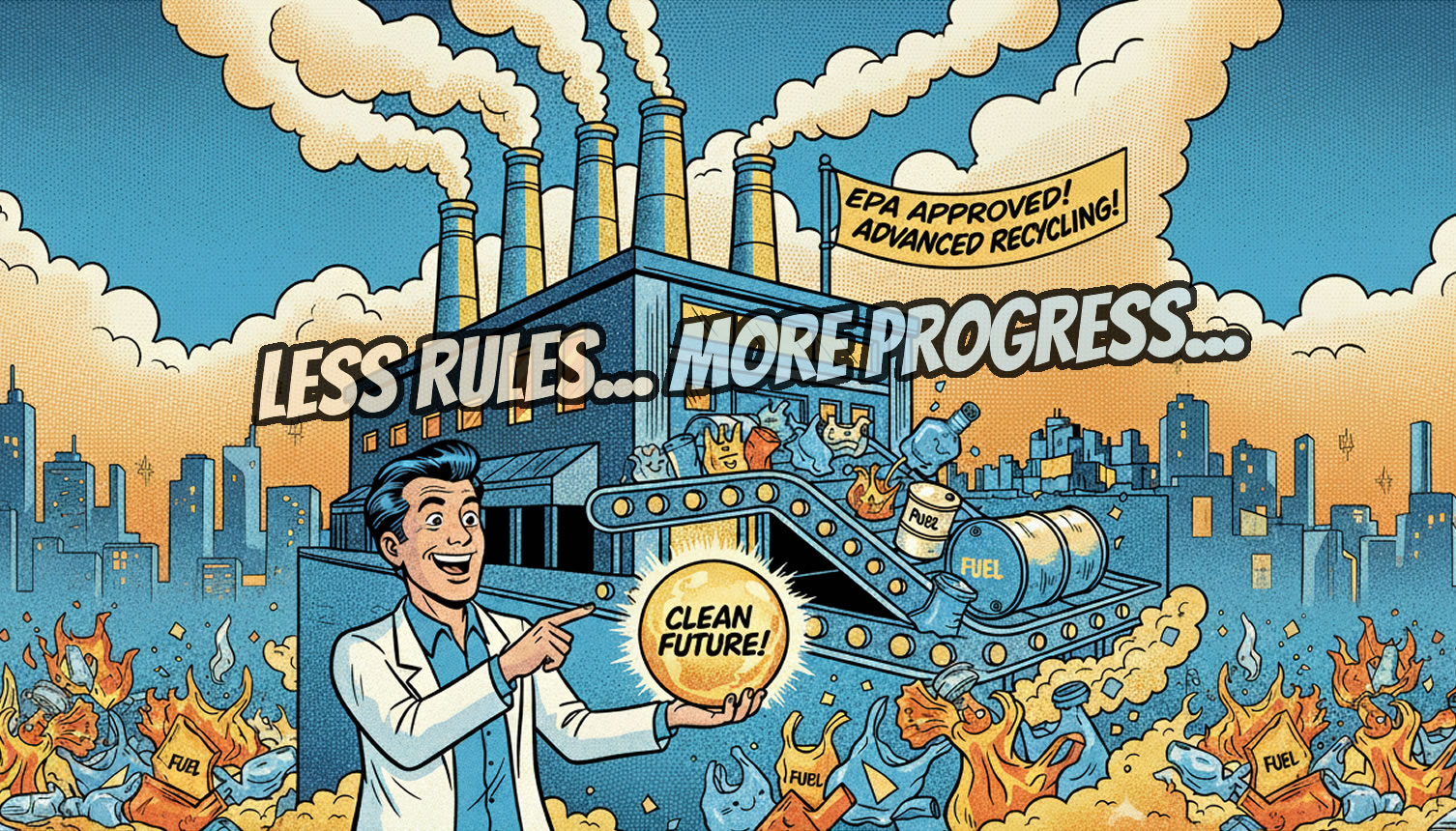
Pyrolysis works by subjecting plastic waste to extreme heat in the absence of oxygen, breaking its molecules down into a synthetic crude oil that can be refined into diesel, gasoline, or other fuels. The plastic industry calls this “advanced recycling” or “chemical recycling.” A 2023 study by scientists at the Department of Energy’s National Renewable Energy Laboratory found that when pyrolysis processes plastic waste, only 0.1 to 6 percent of it can actually become new plastic. The rest becomes fuel. (NRDC, May 2025)
Plastic waste contains lead, phthalates, PFAS, and other toxic additives. When that material is processed through pyrolysis at high heat, those compounds concentrate rather than disappear. In 2022, the EPA approved 18 new chemical mixtures derived from plastic waste pyrolysis for use as fuels, despite the agency’s own analysis finding that some posed extremely high cancer risks. One mixture intended for use as jet fuel was estimated to carry a one in four cancer risk. The EPA issued a proposed rule in 2023 to address those risks. That rule was withdrawn in 2025. (Environmental Defense Fund, August 2025)
The plastics industry has been working toward this reclassification for years, framing it as necessary to scale chemical recycling infrastructure and align with domestic manufacturing goals. The American Chemistry Council applauded the EPA’s proposal, saying it would help address “regulatory uncertainty” that has slowed investment. (Waste Dive, March 24, 2026) Beyond Plastics noted that sixteen representatives for the plastics and fossil fuel industries visited EPA headquarters in the weeks before the proposal was released. (Beyond Plastics, April 2026)
For those tracking organics diversion, pyrolysis is increasingly being positioned as a destination for food-soiled paper, compostable packaging, and other organic materials that can’t easily be mechanically recycled. The pitch is that it diverts material from landfill. The problem is that it routes compostable material away from composting, trades a landfill methane problem for an air toxics problem, and produces fuel that will be burned, generating further emissions. The Zero Waste International Alliance hierarchy explicitly lists pyrolysis among unacceptable disposal methods, alongside incineration and gasification. (ZWIA, 2025)